Showing posts with label Photography. Show all posts

Sunday, November 25, 2012

Interview with Deana Landrum

"Distorted Beauty" Photo By Deana Landrum
As some of you know I interviewed Keith Landrum, the creator of Every Reason Zine last week. In that interview we talked about some of the photography that appeared in the magazine shot by Keith’s wife Deana. I have always found her to be such an inspiration and thought she would complement the previous interview nicely. So please let me do the honor of introducing you to Deana Landrum and show you some of her amazing images.

When did you start your love affair with photography?


"Loxley" Photo By Deana Landrum

Ever since I was little, I've loved taking pictures. In elementary school, my friend and I would pretend we were models and take pictures of each other. I still have them, they're hilariously bad. I was a terrible photographer. In 1995 my friend Scott got me a job at a camera shop where he worked. Until then, I had no idea how much control the person who printed the photos had and how much a difference a SLR made. It made me want a SLR. I didn't get one until several years after that, when my dad bought me one for Christmas. I bought the book they used to teach photography class at our local college and another book on exposure. I read every chance I got and spent a ton of money practicing. I guess the actual beginning, was when I got a SLR.

"Abandoned" Photo by Deana Landrum


Do you prefer black and white photography?
 
No not necessarily. It really just depends on what I'm shooting. To me, black and white brings out deeper emotions for me. I think that color can sometimes be distracting, whereas with black and white, I'm automatically drawn to the subject. Like a black and white portrait draws me to the person's eyes and I feel like I can see their character better than if it was in color. I shoot color for things where it's the color that I feel makes it what it is. I think of color as happy and black and white as emotional. Wait. Did I say I don't prefer black and white? Never mind. I take that back.


 "Doofus" Photo by Deana Landrum

What kinds of things do you like to take photos of?

I love old buildings, doors and windows and stairs. They seem so mysterious to me. I always want to know the back story of who lived there. What's really awesome is when I can get a model to pose and add even more interest to the photograph.  


Do you enhance your photos with any kind of software?

That's an area that I really need to work on. Right now I don't do a whole lot of enhancing. Sometimes I use Photoshop or Picasa. I need to learn more about Photoshop. My favorite photos I've taken I shot with film and had them printed by hand. They're beautiful, no enhancing needed.

"Parking Gargage" Photo by Deana Landrum


What camera are you using?

At the moment I'm using a digital Canon PowerShot 110. It's just a consumer camera, but it does have a manual setting, which I use most. I had a professional film camera, the Nikon F100, until desperate measures lead to me having to sell it. I still have my Holga though. I love shooting with the Holga and the whole creepy look I get. It's unpredictable and I like the anticipation of seeing how the prints turn out.

"Persistence" Photo By Deana Landrum


What inspires you when taking photos?

I'm inspired by many things, abandoned buildings, light breaking through the trees, fog in the early morning and street lights at night. If I don't see inspiration in the distance, I move closer and shoot in macro mode. Often times, things that look boring at a distance, are truly beautiful, you just have to get closer to see the details.


"The Forest of Eyes" Photo By Deana Landrum

"Woman's Room" Photo By Deana Landrum

Can you describe a typical photo day trip? What is your process? 

Most of the time I'll see things that pique my interest while I'm just out running errands. I remember the spot and will go back to it when I have time and the lighting is good. Usually the whole family goes because my oldest daughter needs to shoot for her photography class. I have a photographer friend and we used to just get in the car, pick a direction and just drive. That was always an adventure and we're planning another long overdue adventure soon.
 

What are your major influences when you are creating photos?

I don't know that I have any specific influences. I just have a drive to capture things through the lens that, oftentimes, gets overlooked. Such as a restroom at a rundown gas station. When I started paying attention and looking for the finer details, I started seeing things in a whole different way.

Who inspires you?

I think everyone inspires me. Everyone who is creative or artistic in some way or another. Just seeing what other people do motivates me to get out and do something myself.


Thank you so much Deana for coming by and sharing your amazing gift with us today, I am so glad to share your images with our readers so they can be inspired by them as well. 

If you are looking for the link to the Keith Landrum interview you can find it here: http://tracieskarbo.blogspot.ca/2012/11/interview-with-keith-landrum.html


Monday, November 12, 2012

Purple Martins at French Creek

 
This August, I went to French Creek to see what there was to see.  I often visit marinas for photo opportunities.  I have a deep affinity to these places and people.  There is something soothing and traditional about the fishing boats.  Perhaps I was a fisherman in a previous life and this is why I feel such an attraction for the sea and all things associated with it. 

On this particular evening my son and I were lucky; there was a setting sun for perfect lighting, and the water was calm, perfect to catch reflections.  But what we didn't know was there were even more surprises in store for us.


Great big crab traps on this boat, along with the floats to mark their location.

While we were walking and looking at the various boats and wondering where they had come from, what stories they would have to tell if they could talk, I could hear birds.  Then I could see the birds.  Something was disturbing them.  They were dive bombing an area and looked like they were after something.  We decided to take a better look.
 
 
What we found were some retired biologists tagging the newest members of the local Purple Martin population in the nesting boxes.

Here you can see them tagging the chicks with metal tags and checking their health and sexes. 

"By 1994, all known nesting pairs in the province were using artificial nest-boxes, mainly erected on pilings." Without human intervention, particularly the provision of nest-boxes, this species would have been lost some time ago.

Purple Martins were originally found in the lower Fraser River lowlands, downtown Vancouver, and the east side of Vancouver Island from Campbell River to Victoria.  The decline of the species have coincided with the establishment of the European Starling and with the removal of old pilings from harbours.  Here you can see him retrieving chicks from one of the boxes to tag below.  He is constantly being dive bombed by the parents of the chicks, and I am surprised that he has never fallen off of the ladder.  Sometimes he is in a boat balancing on the ladder!

The total number of known active martin nests in British Columbia in 1995 was 55.  All but two pairs nested on southern Vancouver Island.
 
 I must tell you again that these people are volunteers, they are not being paid for coming out here and keeping tabs on the population.  These two were retired biologists that believe in the cause and that someone must keep up the work.  There are others too that come out and help them and at the end of the essay I will give you some information if you want to get involved further.
A nest-box program started in Cowichan Bay at this time probably rescuing the species from extirpation in British Columbia.  There are now active Purple Martin sites on Vancouver Island at the Esquimalt Dockyards, Victoria Harbour, the Sooke Basin, the Cowichan estuary, Ladysmith Harbour and the Nanaimo estuary; at Newcastle Island Provincial Marine Park; and on the Lower Mainland at Maple Woodflats and Rocky Point.  The present population is still less then 75 pairs.  The Purple Martin is considered Endangered and is protected from killing or collecting by the Wildlife Act.
 
Purple Martins are the largest swallows in North America.  Adult males are an iridescent purple-black.  Females and immature birds are dark above and pale below.
 

 Long reputed to be an efficient predator of insect pests, this large, dark swallow has for centuries been encouraged to by native people in the American Southwest, and later by wise farmers east of the Rockies.  Highly tolerant of human presence they readily accept colonial nesting boxes.
My son is thrilled when he is encouraged to hold this older chick.
 
Adult males arrive back from migration first, often coming back to the previous years nesting site.  They sing a special early morning song which attracts young males to claim nearby sites.  This is beneficial to the older males in various ways; they are able to mate with the females that the young males are breeding with increasing the number of offspring, they don't have to help with rearing the young because the young males are mated with the females and this ensures that the colony is well-populated.  The young males benefit because the risk of predators is diminished with the older males around, and the older males take the best and safest sites.  Colonies can be one pair to many dozens of pairs.

 
The female alone incubates the eggs for 15 to 19 days.
 
Wintering birds can concentrate in large numbers, on wintering roost site consisting of 5000 birds in Brazil.
 
In British Columbia, Purple Martins almost always select sites near or over open water.  Individuals and groups interested in helping Purple Martins in British Columbia are encouraged to build and erect nest-boxes along the waterfront on southern and eastern Vancouver Island and in the lower mainland.  Boxes should be constructed of cedar, and maintained regularly.  Locations should be chosen that allow easy access for maintenance.
 
For more information:
 
 
With the setting sun it was time to leave our adventure and head back to the car for the long drive home.  My son was full of questions and excitement about what he had seen and the new knowledge he had acquired.  I was grateful for the moments in life where the beauty of all that surrounds us is revealed, most of all happy to have my son there to experience it.  I know today was one of those days that will stick in his mind and he will tell his kids about in years to come.

Friday, November 9, 2012

Fish Hatchery Field Trip


Today we went out for a field trip to the local fish hatchery.  Luckily when we arrived it was a bright and sunny day, a nice reprieve from the rain we have been having. 

The kids were running about here and there, anxious to get going on the nature walk and see what there was to see but once our guide started talking she captivated her young audience with her knowledge and questions.


We passed a stream where you could see some of the salmon dying.  At this point they have spawned and their lifecycle is over and they will become part of the food chain.  Whether it is the animals, insects or bacteria that consume them, the fish’s nutrients will eventually be recycled into the forests and provide fertilizer for the trees and plants.


These grey fish are on the bottom of the stream are covered with bacteria.  They have died and have started the decomposition process that will face all of the fish coming here to spawn.


Another shot where you can see a mix of live and dying fish in a spawning pool.  The female digs a hole for the eggs, then the male comes to fertilize them and once the egg is fertilized it floats to the bottom of the stream and sinks below the grade.  Only two out of the two thousand five hundred eggs will make it back to sea.  This is why hatcheries are helping out with the process.  With their intervention the odds are raised, and as many as twenty two to forty make back to sea.


This is a Nurse Stump.  Its decomposition supports new life.


A huge ant hill


Another huge ant hill
Fallen trees like this one make perfect hiding places for salmon.  Eagles and seagulls are just some of the many birds that come to feast as well as black bear and other animals.


Can you see the female salmon in the middle of the image?


There were many bent trees like this one along the pond.


This is a fish ladder; it helps the fish climb up a stream that is otherwise too steep, or the current too fast to climb naturally.


A huge tree with thick moss all the way up and around it.


This was a big tree on a slant.  So huge it would have taken 4 adults to circle the base.


More remains.


If you look at the back of the stream, almost to the other side of the bank you will see a little bit of the dorsal and back fin sticking out of the water.  This is a male.


A fallen tree that has now become a nurse log.  Supporting various life.


A female salmon in the big pond.


These are the pens they keep the female and male in to harvest the Milt from the males and the Eggs from the females.
 

This male has been put in solitary confinement in special liquid to make him sleepy so the milt can be harvested.
 
Here she is drying off the male to harvest the milt.

This is the amount of the milt that came out of the male.

Now for the female.

The female gets her own bath to make her sleepy.  She, unlike the male, will be killed and her blood drained in order to harvest the eggs.

Examples of the stages of life for young salmon.

Fry: 100 days old

Alevens: 45 days old

Eyed eggs: 22 days old

Eggs: 1 day old

The female being drained.
 

Getting ready to harvest the eggs.
 
 
A bucket full of harvested eggs.

Now the dissection of the female occurs.  The lucky male still has a couple more days worth of milting ahead of him.

This is a gill fin.  It covers the gills and help keep them free of debris.

These are the actual gills and I have been told they feel like “wet feathers”.

This is the fish heart.  It was quite remarkable seeing this because it kept beating after removal.  The woman told us this was due to nerves still firing.  I think she might have thought that this would inspire the kids.  But most of them moved on at this point, leaving only the brave and most of the adults to witness the rest of the dissection.
 

The fish liver.

 
The spleen

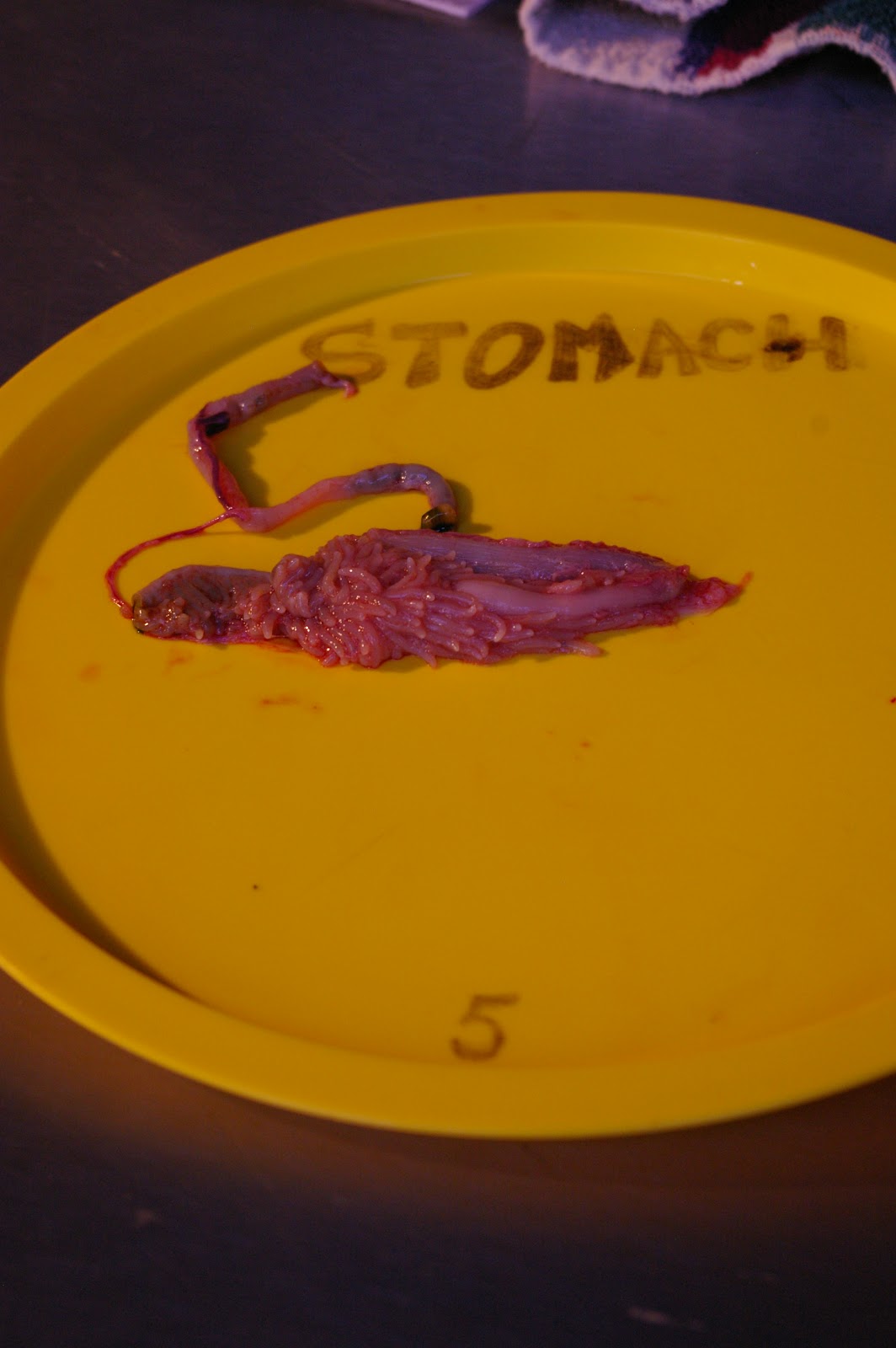
The stomach

The egg sac and some of the eggs that were not squeezed out previously.

The swim bladder, this is the part of the fish that allows the fish to be buoyant or to sink to the depths of the sea or rivers.


Unlike us fish have only one long kidney.
 
The dissection table.

The brain
 
The lens from inside the eye.

Feeding time for the young fry.
 
 
The young salmon feeding on the thrown pellets.

Scarring on the board from a bear in search of a quick lunch.